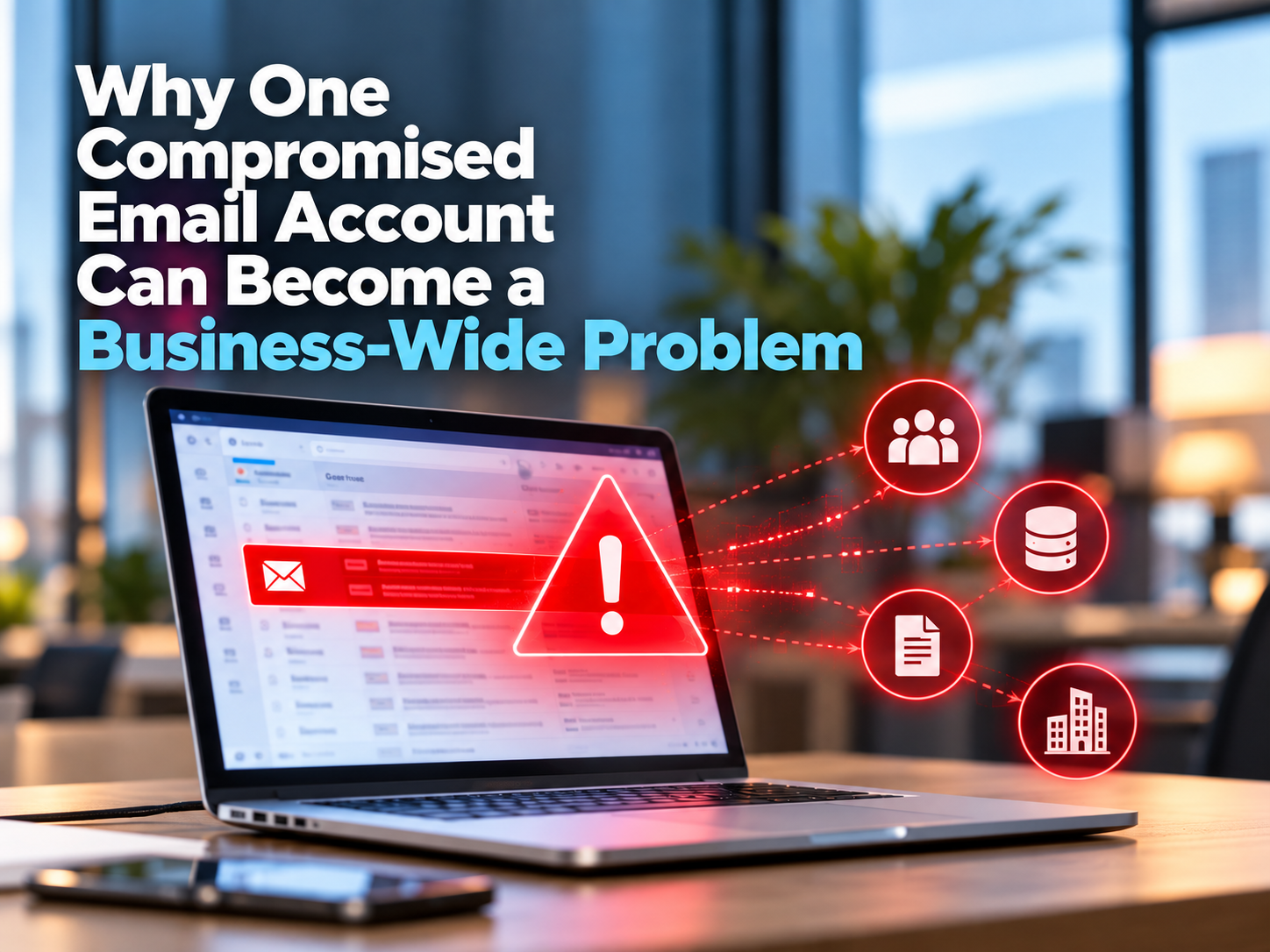
Imagine an employee enters their Microsoft 365 password into a convincing fake login page.
Nothing obvious happens.
Their computer does not lock up. There is no ransomware message. The employee keeps working.
But somewhere else, an attacker may now have access to that employee’s email account.
At first glance, this might sound like one person’s cybersecurity problem.
It is not.
A compromised business email account can give an attacker something extremely valuable: a trusted identity inside your company. From there, they may be able to read conversations, learn how your organization operates, impersonate the employee, target coworkers, intercept financial conversations, or use the account to attack customers and vendors.
That is why one stolen email password can become a much larger business problem.
Why Is Business Email So Valuable?
Think about how much information passes through an inbox.
Invoices, customer conversations, vendor contacts, calendar invitations, password-reset messages, contracts, internal discussions, travel plans, banking conversations, and links to cloud documents may all show up there.
Your email account does not just contain messages.
It contains context.
That context can make scams much more believable.
An attacker who gains access to a real mailbox may be able to learn who approves payments, which vendors send invoices, who works in accounting, how employees communicate with one another, and what projects are underway.
They no longer have to guess how your business operates.
They can watch.
Attackers May Not Do Anything Right Away
One common misconception about cyberattacks is that something dramatic happens immediately after an account is compromised.
That is not always the case.
If an attacker’s goal is financial fraud, sending a suspicious message right away could expose the compromise. Instead, they may quietly monitor conversations and wait for an opportunity.
Imagine they notice an ongoing conversation between your accounting department and a vendor. A payment is coming. The attacker now knows the people involved, the general context, and how those people normally communicate.
At the right moment, a fraudulent message could be inserted into the conversation saying the vendor changed banks and providing new payment instructions.
Except the new bank account belongs to the attacker.
This type of business email compromise is one reason email security deserves more attention than simply choosing a strong password.
A Real Email Account Is Much More Convincing
Employees are often trained to look for suspicious sender addresses, and that is still useful.
But what happens when the message actually comes from a coworker’s real account?
Suppose an employee receives a message that says:
“I’m tied up in a meeting. Can you send me the login for that vendor account?”
If the sender address is slightly misspelled, the employee may catch it.
But if the message comes from the actual account of someone they work with every day, suspicion naturally drops.
That is what makes account compromise so dangerous.
The attacker is borrowing the trust the employee has already built inside the organization.
One Account Can Create More Opportunities
Email is also connected to many other parts of an employee’s digital identity.
Password-reset messages often go to email. Cloud-document links arrive there. Other accounts may use the same address for authentication and notifications.
If an attacker controls an inbox, they may attempt to use that access to reach additional systems associated with the employee.
What they can actually access depends on the user’s permissions, security configuration, multi-factor authentication, and the systems the company uses. A compromised mailbox does not automatically mean the attacker has access to everything.
But it does mean the email account should not be treated as an isolated application.
For many organizations, it sits close to the center of an employee’s digital identity.
Attackers Can Target Coworkers, Customers, and Vendors
Once an attacker controls a legitimate account, other employees may become the next targets.
A compromised employee could appear to send a coworker a document with a simple message such as, “Can you review this?”
The recipient knows the sender. The request does not seem unusual.
They click.
Now the attacker may have another opportunity to steal credentials or expand access.
The same problem can extend outside the company. Customers and vendors may trust messages that appear to come from your domain, which means one compromised account can potentially damage business relationships as well as internal security.
Mailbox Rules Can Help an Attacker Stay Hidden
Another tactic used in email compromises involves mailbox rules.
An attacker may create a rule that automatically forwards certain messages, moves them to another folder, or hides particular replies.
For example, imagine fraudulent payment instructions are sent to a customer. The customer responds asking to confirm the new banking information.
A malicious mailbox rule could potentially move that reply out of view, allowing the attacker to continue the conversation while the real employee remains unaware.
This is why changing the password matters after an account compromise—but it may not be the only step required.
The more important question is not simply:
“Can the attacker still log in?”
It is:
“What did they do while they had access?”
What Are the Warning Signs?
Not every compromised account produces obvious warning signs, but there are several things employees should know to report.
These can include:
Unexpected MFA prompts
Password-reset notifications they did not initiate
Messages in Sent Items they do not recognize
New forwarding or inbox rules
Coworkers asking about messages they did not send
Login notifications from unusual locations
Any one of these may have an innocent explanation, but they deserve a closer look.
That is why account protections and security monitoring matter. You do not want to depend entirely on an employee noticing something strange after the fact.
What Should You Do If You Think an Account Was Compromised?
Speed matters.
The exact response will depend on your environment, but the first call should generally be to whoever manages your IT and cybersecurity.
The response may include securing the account, resetting credentials, ending active sessions, reviewing multi-factor authentication settings, checking login history, reviewing mailbox rules, and determining whether other systems or accounts were affected.
If financial fraud may have occurred, the financial institution should be contacted immediately.
Most importantly, do not assume the problem is finished because the employee changed their password.
The goal is to understand the full scope of what happened.
How Can Businesses Reduce the Risk?
There is no single tool that eliminates email compromise, but several protections can significantly reduce the risk and limit the impact.
Use multi-factor authentication. Provide employees with ongoing phishing and social-engineering training. Use layered email security designed to help detect malicious links, impersonation attempts, and suspicious messages. Limit user permissions so one compromised account does not have access to more than it needs.
Accounts should also be monitored for unusual activity.
For financial transactions, create a separate verification process for changes to banking or payment instructions. If a vendor emails new banking details, verify the change using a trusted communication method rather than relying only on the email itself.
And make sure employees know what to do when something feels wrong.
An employee who reports an unexpected MFA prompt immediately may give your IT team an opportunity to investigate before a small event becomes a much larger problem.
Email Is More Than Email
That may be the most important takeaway.
Business email is not simply a place where messages arrive. It is connected to employees, customers, vendors, calendars, cloud files, authentication, financial conversations, and everyday workflows.
That is why protecting email deserves more attention than simply choosing a strong password.
One compromised inbox can give an attacker information. That information can create credibility, and credibility creates opportunity.
So if someone on your team ever says:
“It’s only one email account.”
That is exactly why it should be taken seriously.