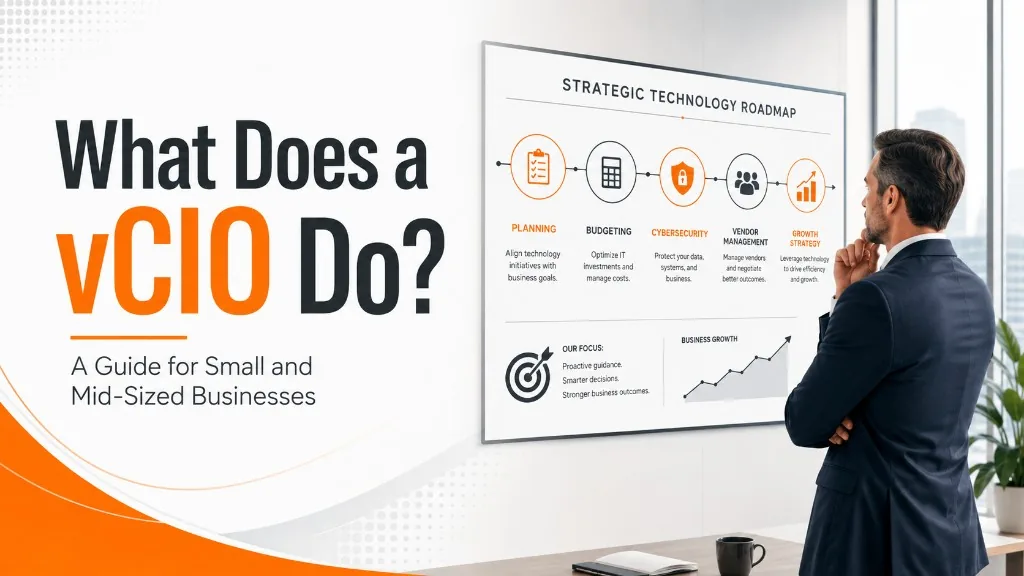
For many businesses, IT starts out fairly simple.
Someone handles computer problems. A vendor manages the internet connection. Software gets added as it is needed. Computers are replaced when they become too slow. Backups are configured, cybersecurity tools are added, and day-to-day technology issues are addressed as they come up.
That approach may work for a while.
But as a business grows, technology decisions tend to become more complicated. There are more employees, more software platforms, more devices, more vendors, more cybersecurity concerns, and often more pressure to plan ahead.
At that point, simply having someone who can fix technology problems may no longer be enough.
The business may also need someone looking at the bigger picture.
That is where a virtual Chief Information Officer, or vCIO, can play an important role.
What Is a vCIO?
A vCIO is a technology advisor who helps a business make strategic decisions about its IT environment.
Instead of focusing primarily on troubleshooting individual issues, a vCIO looks at how technology supports the organization as a whole.
That may include questions such as:
- What technology will need to be replaced in the next few years?
- What should the company budget for?
- Are current systems capable of supporting future growth?
- Which cybersecurity risks should be addressed first?
- Are there software or vendor contracts that should be reconsidered?
- What technology projects should take priority?
- Are IT decisions aligned with the company's business goals?
In many cases, a vCIO works alongside a managed IT provider or internal IT team. The technical team handles the day-to-day work, while the vCIO helps create the longer-term direction.
The two functions are related, but they are not the same.
A Help Desk Keeps Technology Running. A vCIO Helps Decide Where It Is Going.
Traditional IT support is largely operational.
When an employee cannot access email, a computer stops working, a printer disconnects, or a network problem appears, the help desk works to resolve the issue.
Those services are essential.
But fixing problems does not automatically create a technology strategy.
A company can have good technical support and still make important technology decisions reactively.
For example, a server may only be replaced after it becomes unreliable. Software may be purchased because one department needs something immediately. Cybersecurity tools may be added one at a time without looking at how they work together. Major expenses may appear unexpectedly because no one was tracking the age of equipment.
A vCIO helps connect those individual decisions into a larger plan.
What Does a vCIO Actually Do?
The exact responsibilities vary depending on the business, but several areas commonly fall under strategic technology leadership.
Build a Technology Roadmap
One of the most important responsibilities is creating a roadmap for the company's technology environment.
A technology roadmap identifies what the organization has today, where changes may be needed, and which projects should happen first.
For example, a roadmap might identify that several workstations should be replaced during the next budget cycle, a server will reach the end of its useful life within two years, or a business application should eventually move to a cloud platform.
Planning those changes in advance gives the company time to evaluate options instead of making major decisions during an emergency.
Help Build an IT Budget
Technology expenses can become difficult to predict when equipment and software are purchased only when something goes wrong.
A vCIO can help turn those surprises into planned expenses.
That may include forecasting hardware replacements, software renewals, cybersecurity investments, infrastructure upgrades, cloud services, and larger technology projects.
The goal is not simply to spend more on IT.
It is to help leadership understand what is coming and make informed decisions about timing, priority, and cost.
Evaluate Technology From a Business Perspective
A business rarely buys technology simply because it wants more technology.
It buys technology because it wants to accomplish something.
Maybe the company wants to add employees, open another location, improve customer service, reduce downtime, strengthen security, or make a process more efficient.
A vCIO can help evaluate technology decisions through that lens.
Instead of asking only, "Which product has the best technical specifications?" the conversation becomes:
Which option makes the most sense for this business?
That distinction matters.
The most powerful or expensive solution is not always the right one. A good technology strategy considers cost, usability, security, reliability, growth, and how employees actually work.
Prioritize Cybersecurity Risk
Cybersecurity is also increasingly connected to strategic IT planning.
Most businesses cannot address every possible risk at once. The more useful approach is to identify the areas that create the greatest exposure and prioritize improvements accordingly.
A vCIO may help leadership look at issues such as:
- Multifactor authentication
- Endpoint protection
- Backup and disaster recovery
- Employee cybersecurity awareness
- Access controls
- Vulnerability management
- Software updates
- Cyber insurance requirements
- Incident response planning
A vCIO is not necessarily a dedicated Chief Information Security Officer, or CISO, and the two roles should not be treated as interchangeable.
However, technology strategy and cybersecurity strategy increasingly overlap. Decisions about software, infrastructure, remote access, vendors, and growth can all create security implications.
Coordinate Vendors and Major Technology Decisions
Most businesses rely on more technology vendors than they realize.
There may be internet providers, phone systems, software companies, cloud platforms, cybersecurity products, line-of-business applications, copier vendors, payment systems, and specialized equipment.
Without someone overseeing the larger environment, those services can become fragmented.
A vCIO can help evaluate vendors, identify overlapping services, plan major changes, and make sure technology decisions fit within the broader roadmap.
This can be particularly helpful when a company is considering a large software implementation, moving offices, adding a location, changing business systems, or preparing for significant growth.
How Is a vCIO Different From a Full-Time CIO?
A traditional CIO is typically a senior executive responsible for an organization's overall technology strategy.
Larger organizations may need that role full time.
Many small and mid-sized businesses do not.
They may benefit from experienced strategic technology leadership without requiring a full-time executive dedicated solely to IT.
The vCIO model gives those businesses access to ongoing technology planning and executive-level guidance without assuming they need a full-time CIO position.
It is often used alongside managed IT services, where the same technology partner may provide both operational support and strategic planning.
How Do You Know If Your Business Needs More Strategic IT Guidance?
A business does not have to reach a specific employee count before technology strategy becomes important.
Complexity matters more than size.
A 25-person company with multiple locations, cloud applications, industry-specific software, remote employees, and sensitive customer data may have more complicated technology needs than a much larger business operating from one location with relatively simple systems.
There are several signs that a business may need more strategic oversight.
- Technology decisions are constantly being made in response to emergencies.
- Major IT expenses are difficult to predict.
- Leadership does not have a clear picture of which systems will need to be replaced.
- Cybersecurity projects happen individually rather than as part of a broader plan.
- Different departments purchase technology without much coordination.
- The business is planning to grow, hire significantly, acquire another company, or open another location.
Or perhaps the most important sign: no one can clearly explain what the company's technology priorities are for the next 12 to 36 months.
What Should a Strategic Technology Review Cover?
A useful strategic IT conversation should go well beyond a report showing ticket counts or system uptime.
Leadership should be able to discuss questions like:
- What has changed since the last review?
- What technology risks should we be aware of?
- What systems are aging?
- What cybersecurity improvements should be prioritized?
- Are backups and business continuity plans keeping pace with the organization?
- What technology projects are coming next?
- What should we budget for?
- Are there tools, vendors, or licenses we no longer need?
- What business goals are coming that technology will need to support?
The purpose is not to create a complicated technology plan for the sake of having one.
It is to make sure IT decisions support where the business is trying to go.
Good IT Support Solves Today's Problems. Good IT Strategy Prepares for Tomorrow's.
A responsive help desk is important. Reliable infrastructure is important. Cybersecurity is important.
But as a business becomes more dependent on technology, maintaining systems and planning technology can no longer be treated as the same thing.
The businesses that manage technology well are not necessarily the ones buying the newest equipment or the most expensive software.
They are the ones making deliberate decisions.
They know what they have, what needs attention, what is coming next, and why they are investing in it.
That is ultimately the role of a vCIO: helping turn technology from a collection of computers, applications, vendors, and expenses into a plan that supports the business.
For growing small and mid-sized companies, that strategic layer can be the difference between constantly reacting to technology and actually being prepared for what comes next.
At Superior Technical Solutions, we help businesses combine day-to-day IT support with that longer-term view—so leadership has a clear picture of the environment, a practical roadmap, and a budget that matches where the company is going.
If you are not sure whether your organization has that strategic layer, schedule a conversation with STS to talk through your technology priorities for the next 12 to 36 months.