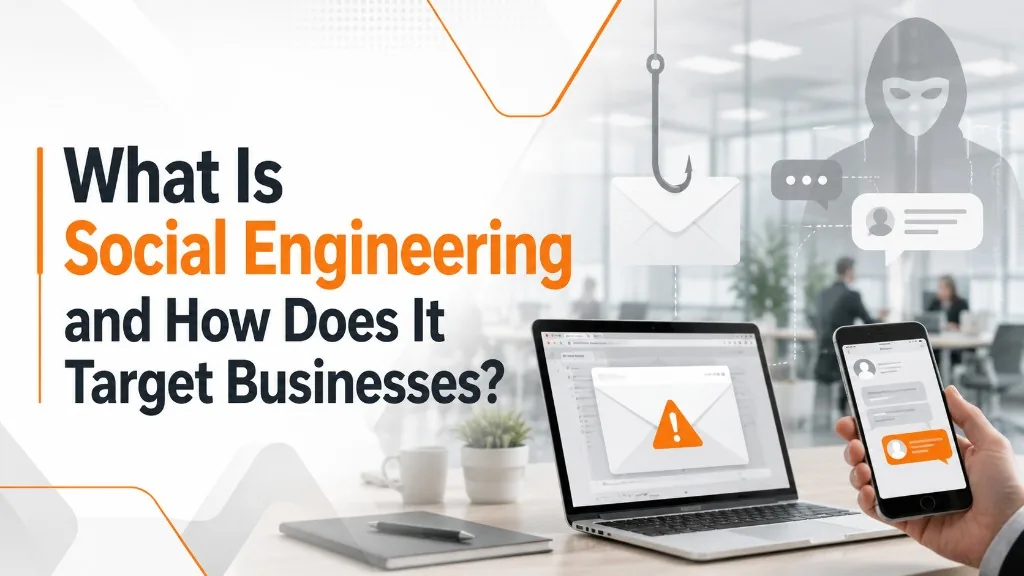
Some cyberattacks begin with malware.
Others begin with a conversation.
A phone call from someone claiming to be a vendor. An email that looks like it came from the CEO. A text message asking an employee to verify an account. A fake login page that looks almost identical to Microsoft 365.
The technology behind these attacks can vary, but the strategy is often the same:
Convince a person to do something they normally would not do.
That is social engineering.
Social engineering is a cybersecurity attack that uses manipulation, trust, urgency, fear, authority, or curiosity to influence someone into revealing information, sending money, granting access, or taking another action that benefits the attacker.
For businesses, this matters because even strong technical security can be weakened if an attacker successfully convinces an employee to open the door.
Understanding how social engineering works is one of the most important steps a business can take to reduce human cybersecurity risk.
Why Do Social Engineering Attacks Work?
Social engineering works because attackers understand something simple:
People are busy.
Employees move quickly. They answer emails between meetings, respond to customers, approve invoices, reset passwords, and handle dozens of small decisions every day.
Attackers take advantage of that.
Instead of asking, "How can I break through this company's firewall?" they may ask:
"How can I make someone believe I am supposed to be here?"
A convincing attacker may impersonate:
- A manager
- A coworker
- A vendor
- A bank
- Microsoft or another technology provider
- A customer
- A delivery company
- An IT technician
- A government agency
The goal is usually to make the request feel familiar enough that the employee acts before verifying it.
The Psychology Behind Social Engineering
Most social engineering attacks rely on a few common psychological triggers.
Urgency
Attackers want people to act quickly.
You may see messages like:
"Your account will be disabled in 30 minutes."
"We need this wire sent before the bank closes."
"Your password expires today."
Urgency reduces the chance that someone will stop, question the request, or ask another person for confirmation.
Authority
People are naturally more likely to respond to someone they believe has authority.
An attacker may impersonate an owner, executive, manager, doctor, attorney, or IT provider.
An employee may think:
"I should probably do this because my boss asked."
That instinct can override caution.
Familiarity
Social engineering is more effective when the message looks normal.
Attackers may copy company logos, email signatures, writing styles, or actual vendor names.
They may even research employees on LinkedIn or company websites before sending a message.
The more familiar the request feels, the easier it is to trust.
Fear
Threatening consequences can also push someone to act quickly.
Messages may claim:
- An account has been compromised
- A payment failed
- A legal issue has occurred
- Access will be suspended
- A security incident needs immediate attention
The attacker wants the person focused on the consequence, not the legitimacy of the request.
Curiosity
Not every attack uses fear.
Sometimes the hook is simply interesting enough to click.
Examples might include:
- "Updated salary information"
- "Confidential employee list"
- "Photos from the company event"
- "You received a secure document"
- "Someone shared a file with you"
Curiosity can be just as effective as urgency.
Common Types of Social Engineering Attacks
Social engineering can take many forms. Some are highly technical, while others are surprisingly simple.
1. Phishing Emails
Phishing is one of the most common types of social engineering.
Attackers send emails designed to make the recipient click a link, download a file, enter credentials, or provide information.
The message may appear to come from Microsoft, a financial institution, a vendor, or someone inside the company.
Modern phishing emails can look extremely convincing.
That is why businesses should not rely on employees being able to spot every fake message perfectly.
Strong email security should work alongside employee training.
2. Business Email Compromise
Business email compromise, or BEC, is especially dangerous because it often focuses directly on money.
An attacker may impersonate an executive, accounting employee, vendor, or customer and request:
- A wire transfer
- A change in banking information
- Payment of an invoice
- Gift card purchases
- Sensitive financial documents
In some cases, attackers actually compromise a real email account and monitor conversations before making the request.
That makes the message much harder to recognize as fraudulent.
A simple process requiring secondary verification for financial changes can prevent significant losses.
3. Smishing
Smishing is phishing through text messages.
Employees may receive a text claiming to be from a delivery service, bank, executive, or technology company.
For example:
"Your Microsoft account has been locked. Verify here."
Or:
"This is John. I'm in a meeting. Can you grab a few gift cards for me?"
Text messages often feel more personal and immediate than email, which can make them effective.
4. Vishing
Vishing is social engineering conducted over the phone.
An attacker may pretend to be from IT support, a bank, a vendor, or another trusted organization.
They may ask the employee to:
- Read a verification code
- Reset a password
- Install software
- Provide account information
- Allow remote access to a computer
Employees should know that legitimate IT support should have established processes for identity verification.
A convincing voice on the phone is not proof that the caller is legitimate.
5. Fake Login Pages
Many social engineering attacks lead employees to websites that closely imitate legitimate services.
The page may look like Microsoft 365, Google, Dropbox, a bank, or another familiar platform.
The employee enters a username and password, and the attacker captures the credentials.
The fake site may then redirect the employee to the real website, making it appear that nothing unusual happened.
This is another reason multi-factor authentication and security monitoring are so important.
6. Impersonating IT Support
Attackers know employees are used to receiving help from IT.
A criminal may call or email an employee and say:
"We detected a problem with your computer and need to connect remotely."
If the employee allows access, the attacker may gain control of the device.
This type of attack can be especially effective when employees do not know who their actual IT provider is or what normal support procedures look like.
Businesses should make it clear how legitimate IT support communicates with employees.
Social Engineering Is Not Always Digital
It is easy to think social engineering only happens through email or text messages.
It does not.
An attacker might walk into an office pretending to be a delivery driver, technician, contractor, or vendor.
They may ask someone to hold a secure door open.
They might request access to a server room or office area.
They may call the front desk and ask for information about employees, schedules, software, or vendors.
Small pieces of information can help build a much more convincing attack later.
Cybersecurity includes physical and procedural awareness, not just technology.
Why Are Businesses Such Attractive Targets?
Businesses have something cybercriminals want:
Access.
That access may lead to money, customer information, employee data, cloud systems, email accounts, intellectual property, or trusted relationships with other organizations.
Attackers also know that business environments often have predictable workflows.
Invoices get paid.
Employees reset passwords.
Managers request files.
Vendors send documents.
Executives travel.
IT asks employees to install software.
Social engineering works by blending malicious requests into those normal business activities.
How Can Businesses Reduce Social Engineering Risk?
Employee training is important, but it should not be the only defense.
Businesses should create several layers of protection.
That includes:
- Regular cybersecurity awareness training
- Phishing simulations
- Strong email filtering
- Multi-factor authentication
- Password managers
- Restricted administrative privileges
- Clear financial approval processes
- Established IT support procedures
- Security monitoring
- Endpoint protection
- Incident-response planning
Employees should also be encouraged to verify unusual requests using a second communication method.
For example, if an email asks an employee to change a vendor's banking information, they should call the vendor using a known phone number.
Do not use the phone number listed in the suspicious email.
Teach Employees to Slow Down
One of the best defenses against social engineering is a simple habit:
Pause before acting on unusual requests.
Employees should ask:
- Was I expecting this?
- Is this request unusually urgent?
- Is someone asking me to bypass a normal process?
- Am I being asked for a password, code, payment, or sensitive information?
- Does the sender normally communicate this way?
- Can I verify the request another way?
A 30-second pause can prevent a much larger problem.
The Goal Is Not to Make Employees Suspicious of Everything
Businesses still need employees to communicate, collaborate, serve customers, and make decisions.
The goal is not to create an environment where everyone is afraid to click anything or answer a phone call.
The goal is to build good instincts.
Employees should feel comfortable questioning requests that are unusual, urgent, financial, or related to account access.
They should also know that reporting something suspicious is a positive action, not an inconvenience.
Social Engineering Works Best When Security Depends on Trust Alone
Cybercriminals are constantly looking for ways around technical defenses.
Cybercriminals frequently target people because manipulating a trusted user can allow them to bypass technical safeguards altogether.
That does not mean employees are the problem.
It means businesses need security that recognizes how people actually work.
At Superior Technical Solutions, we help businesses build cybersecurity strategies that combine technology, employee awareness, monitoring, access controls, and clear processes.
Because preventing social engineering is not about expecting every employee to identify every attack.
It is about making sure one convincing email, phone call, or text message does not have the power to compromise your entire business.